
 Next Day Delivery Available
  Local Delivery Included*
 Extensive Show Garden
 Ethically Sourced
How Is Indian Sandstone Quarried in Rajasthan?
Rajasthan, in north-west India, is one of the world’s largest producers of natural sandstone. The region has been quarrying stone for hundreds of years, with some areas supplying stone for historic forts, palaces and temples that are still standing today.


Why Rajasthan?
Rajasthan sits on vast deposits of sedimentary rock that formed around 100–200 million years ago, when much of the area was covered by shallow seas, rivers and ancient deserts. Over millions of years, layers of sand were compressed into the sandstone we use today.
The region’s geology creates a wide variety of colours, including:
- Raj Green
- Kandla Grey
- Mint
- Autumn Brown
- Fossil Mint
- Rippon Buff
- Rainbow Sandstone
The unique mix of minerals in each layer gives every slab its own colour and character.
Step 1: Finding the Stone
Before quarrying begins, geologists and quarry managers inspect the site to identify high-quality sandstone beds.
They assess:
- Stone thickness
- Colour consistency
- Natural faults and cracks
- Rock strength
- Ease of extraction
Because sandstone occurs in layers, quarry operators carefully plan where to cut to maximise usable material and reduce waste.
Step 2: Removing the Overburden
The sandstone isn’t always visible at the surface.
Workers first remove the soil, clay and loose rock that sits above the sandstone. This material, known as overburden, is stripped away using excavators, bulldozers and loaders until the solid stone is exposed.
Step 3: Cutting the Blocks
Unlike blasting used in some hard-rock quarries, sandstone is usually extracted by making controlled cuts.
Large stone blocks are separated using:
- Diamond wire saws
- Circular stone saws
- Hydraulic splitters
- Pneumatic tools
- Wedges inserted into drilled holes
These methods help minimise cracking and preserve the stone’s natural quality.
Step 4: Lifting the Stone
Once a block has been freed, heavy machinery such as cranes, excavators or loaders lifts it from the quarry floor.
Some blocks can weigh several tonnes, so careful handling is essential to avoid damage.
Step 5: Transport to the Processing Yard
The rough blocks are transported from the quarry to nearby processing facilities, where they are cut into slabs and paving.
Here they are:
- Sawn to the required thickness
- Cut into standard sizes (such as 900 × 600 mm or project packs)
- Hand dressed if required
- Calibrated for a more consistent thickness (depending on the product)
- Checked for quality before packing
Step 6: Hand Finishing
One feature that makes Indian sandstone so distinctive is the amount of craftsmanship involved.
Many products are still finished by skilled workers who:
- Hand cut edges
- Create naturally riven surfaces
- Produce hand-dressed finishes
- Tumble the stone for a weathered appearance
- Sort slabs by colour and quality
This process means no two pieces are ever exactly the same.
Step 7: Packing and Shipping
After inspection, the stone is stacked onto pallets, securely strapped and prepared for export.
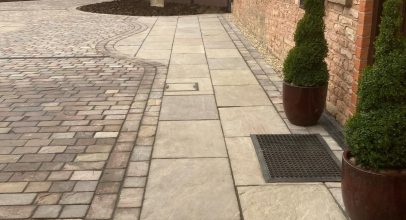
It is then transported by road to ports before being shipped around the world, including to the UK, where it becomes patios, pathways, driveways and garden features.
Why Every Slab Looks Different
One of the biggest misconceptions is that every pallet should look identical.
Natural sandstone is a product of geology, not a factory. Each slab comes from a different part of the rock formation and may contain:
- Colour variation
- Fossil markings
- Quartz veins
- Iron oxide patterns
- Natural riven textures
- Mineral deposits
These differences aren’t defects—they’re part of what makes natural stone unique.
Why This Matters to Homeowners
When you choose Indian sandstone, you’re not buying a manufactured product. You’re choosing a material that has taken millions of years to form and has been carefully quarried, crafted and finished by skilled workers.
The result is a patio or garden that has genuine character, natural durability and a unique appearance that can’t be replicated by artificial materials.



 Basket
 Account
 01909 772 302